New Montreal Incursion
Tinea and Leah: [Cyberpunk, Alien Incursions, Murder and Mayhem, Girl's Love (WLW)]The New Montreal Incursion is the formative crisis that turns Aden Rheinschiffer's latent readiness into immediate combat responsibility. Beginning as a warning overlaid on an ordinary weapons practice session, it expands from a localized assault at the edge of New Montreal into part of a synchronized global invasion. The event reveals both the Antithesis's material method of growth and the emergency society built around resisting it: civilians are trapped, private samurai become local defenders, Family personnel coordinate requests, and inexperienced Vanguards are pushed toward battle before any conventional authority can restore normality.
Detection and First Sight
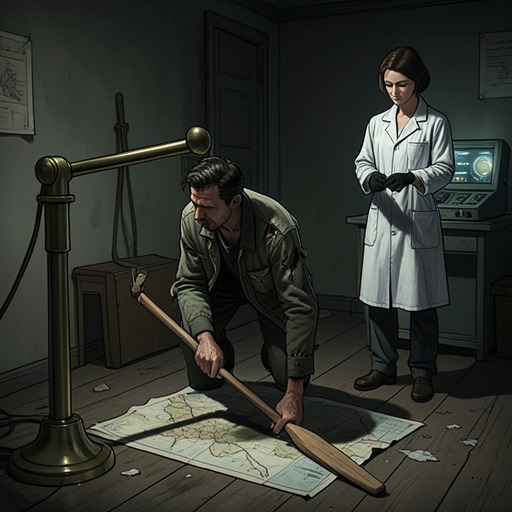
Aden first encounters the incursion through the abrupt appearance of the warning “Incursion Detected!” while he is practicing with a bow and preparing to move to a rifle range. The interruption is significant because it cuts across a controlled ritual of concentration, safety checks, ammunition preparation, and deliberate movement. Practice has been a private rehearsal for violence; the warning makes violence present before Aden has chosen a target or entered a fight.
He returns to his condominium to gain a wider view. Although the building is only five floors tall, it is one of the higher structures in the suburban area of New Montreal, positioned between a broad shopping strip and the road behind it. From the roof, Aden sees the sky painted crimson, with the deepest color over New Montreal. Giant fleshy ropes descend over the megacity, tall buildings burn, and distant explosions flicker beyond the range of clear sound. The first affected area is only several kilometers wide and lies near the city's edge, but the limited initial footprint is deceptive: Aden immediately understands that the incursion will grow.
The Suburban Breach
The invasion reaches the outskirts of Aden's neighborhood as sirens begin sounding. Two of the descending ropes crash near the suburb. One destroys several houses; the other falls across the shopping strip a few hundred meters away, crushing cars and buses and blocking the entrance to the community shelter. The obstruction converts a military threat into an immediate civilian emergency. The buses contain passengers, and the cars probably contain people as well, but the absence of visible blood does not make the crushing less consequential. Aden's physical fear becomes part of the event: his heart pounds, his hands sweat, and he worries that killing people might make him revert to an earlier self.
He nevertheless decides to fight. The decision is not presented as confidence without cost. Aden fears what the act of killing will do to him, recalls images of masks sliding from bleeding faces, and forces those memories away. His response is therefore both tactical and psychological: he breathes, regains control, and chooses the field in which he knows himself to be most capable.
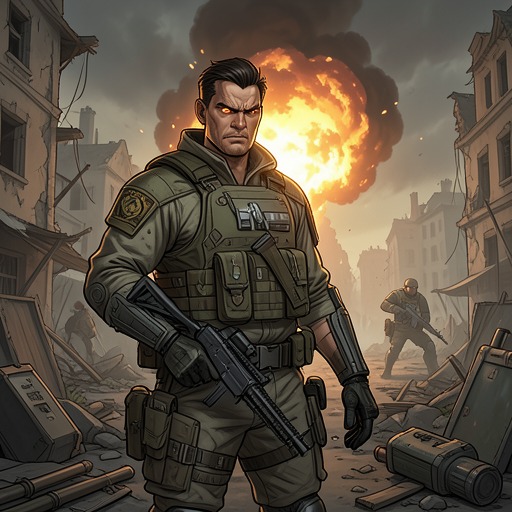
The ropes release hundreds of black-plated, dog-like Antithesis Model Threes and begin producing greenish-pink fruit blisters. The blisters will flower into additional Model Threes and into Model Ones, whose bodies resemble strange artificial pigeons. Later, when Aden turns toward New Montreal again, the threat has become more legible but no less alarming. Tracer fire crosses the sky while anti-aircraft guns maintain a steady background rhythm. Model Threes sniff around doors, rush shop windows, and search for people hiding beneath tables or behind bars. Some civilians possess pistols but do not know how to use them effectively, a contrast with Aden's insistence that weapons require practice before a crisis.
Growth, Containment, and the Military Response
The incursion continues while Aden observes and prepares. After two and a half hours, the timer is still running. With Tynea's assistance, he receives a three-dimensional render assembled from local security cameras. The image shows hordes of Antithesis moving through New Montreal in long, orderly rows, even following road rules as they advance through the streets. Their apparent order gives the invasion an unsettling civic imitation: the creatures do not merely swarm; they occupy the infrastructure of the city and move through it like traffic.
Older and stronger samurai destroy thousands of Antithesis, yet the destruction does not halt the advance. New creatures continue to arrive and press deeper into the city. Temporary military bases form a cordon, stemming and redirecting the tides back upon themselves. The defense therefore operates through layered containment rather than a decisive victory. The city survives in the immediate term, but survival requires constant expenditure of force against an enemy whose supply appears effectively continuous.
A museum roof becomes one visible defensive position. A samurai-tech railgun installed there blasts through waves of Model Ones and occasional larger Model Elevens. A girl Vanguard protects the emplacement, using grenades, guns, and two shoulder-mounted mini-railguns against single-digit models climbing the museum walls. Aden cannot determine whether she is inexperienced or merely specialized for a role other than direct combat, but he recognizes that her equipment is only barely keeping pace with the massed aliens. Her position also has a humanitarian purpose: buses are leaving the building she protects, and Aden infers that she is deliberately making herself the primary threat so the passengers have a better chance of escaping intact.
The Antithesis attacking the museum are not the weak, undersized creatures Aden first faces. They have had time to grow inside growth sacks, making them faster, more resilient, and quicker to react to gunfire. Aden judges that he would not have survived a horde of them without spending substantially more points on larger and better weapons. The veteran defender compensates through tactics and equipment, using explosives to throw creatures from the roof and four barrels to shred them by the dozen while remaining in the one corner outside the main gun's point-defense coverage.
From Local Crisis to Global Invasion
The New Montreal attack is eventually identified as one component of a truly global event. Laserjack, who manages regional defense against the Antithesis, tells Aden and Tinea that some cities have already fallen while New Montreal is expected to hold. Thousands of hidden hives have become active simultaneously after an alien pheromone signal. Corporate cities and towns are less secure than New Montreal, and lone samurai are defending entire communities by themselves even as new Vanguards continue to appear. Laserjack's warning to Tinea is consequently both an operational instruction and a statement of the crisis's generational pressure: she must become strong quickly and survive because the existing defenders cannot cover every location.
The event also exposes an emergency authority that is neither a conventional government nor a fully centralized military. The Family functions as a local, informal coordinating body for samurai operations, acting more as a facilitator than a regulator. It connects requests for bombardment with the people able to pull the trigger. During the broader crisis, this arrangement allows individual defenders to request large-scale intervention while preserving the decentralized character of samurai warfare.
A later Antithesis swarm demonstrates how the invasion's consequences extend beyond the city itself. The swarm moves along a route that could carry it past abandoned farmsteads and mechanized tree farms toward the St. Lawrence River, then onward toward Quebec and New Montreal. It is already large enough to take another day to pass the area and may gather hundreds of thousands more, potentially exceeding a million. Tinea contacts Family support and asks that the swarm be monitored and destroyed if it approaches settlements, declaring an intention to kill as many Antithesis as possible over the following days. The request shows how the New Montreal Incursion has changed the meaning of defense: protecting one neighborhood gives way to tracking migratory masses across a region and coordinating force before civilian centers are reached.
Historical Scale and Significance
The incursion's scale is finally placed against the later devastation of the German Deadzone, where nuclear strikes stretch from Cologne to Hamburg and Nuremberg, past Berlin and into Poland, with fallout threatening metropolises far beyond the directly destroyed region. That comparison makes New Montreal an early local expression of a catastrophe capable of rearranging continents. The later construction of the world's first ABC city, designed to shelter millions from nuclear winter, Antithesis attacks, and chemical and radiological devastation, confirms that the invasion belongs to a transformation of civilization rather than an isolated urban battle.
Within the narrative, New Montreal is decisive because it joins intimate fear to systems-level revelation. A blocked shelter, crushed vehicles, frightened civilians, and a defender watching from a condominium roof coexist with timers, surveillance renders, military cordons, railguns, pheromone signals, and Family coordination. The event begins with a single warning and ends by revealing a world in which hidden hives can awaken everywhere at once. Aden's first sight of the crimson sky therefore marks more than the arrival of enemies in one city: it is the moment ordinary preparation becomes a permanent condition of life.